How a hepatology leader moved a reimbursement argument from price per pack to total cost of care

- 95.0% / 70.0% reported adherence: two pills a day versus six pills a day of the same molecule
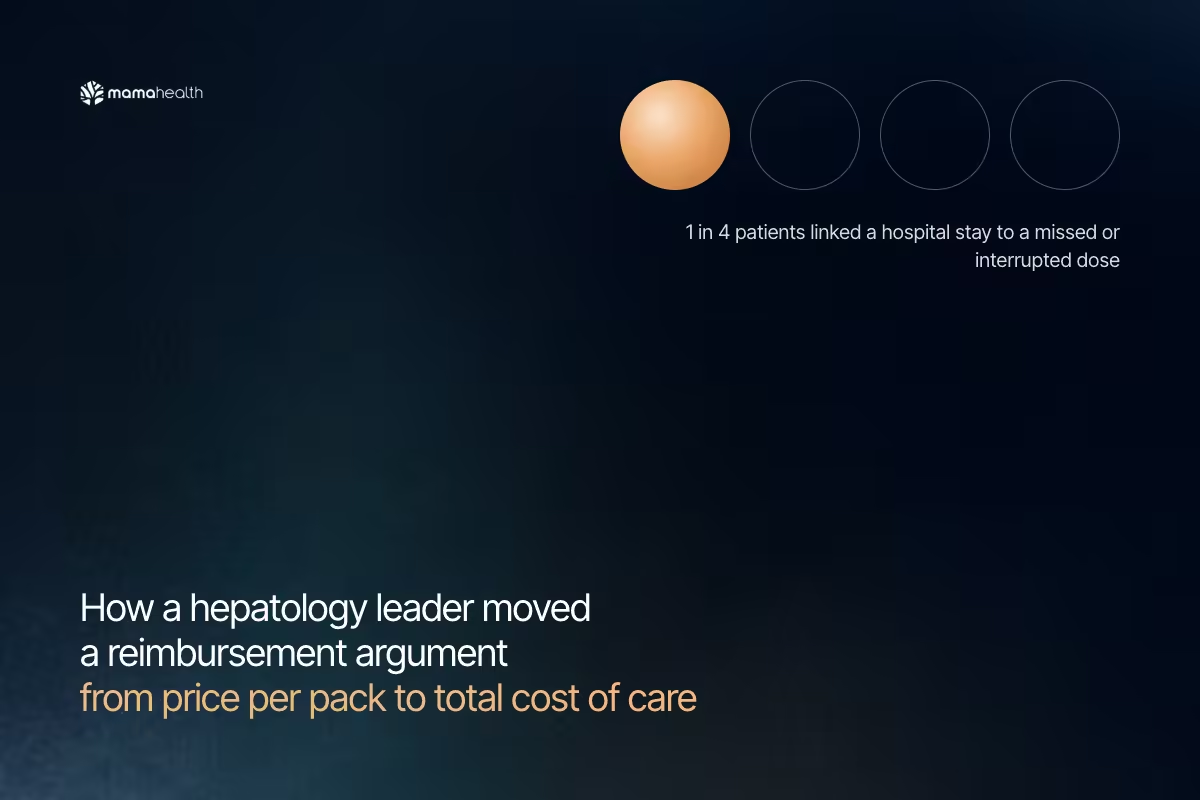
- 1 in 4 patients linked a hospital stay to a missed or interrupted dose
- 3 or 4 days for a pack on six pills a day, against about a month for a pack on two
About the client
The client is a pharmaceutical company and market leader in the management of a hepatic condition. Its asset is mature and well established, and it comes as one molecule in two formulations:
- Higher dose, two pills a day. Only a specialist can prescribe it, in this case a hepatologist. Two pills a day, for life.
- Lower dose, six pills a day. Any physician can prescribe it. Each pill is one third the strength, so the same daily dose means six pills a day.
Over the years, payers have come to treat the two versions of the same molecule as interchangeable. They often reimburse only the lower dose, because it's the same molecule at a far lower cost.
The challenge
The total amount of drug is identical in both regimens. From the payer's side, there's nothing to choose between them. From the patient's side, there is.
Six pills a day empties a pack in three or four days. Two pills a day lasts about a month. So a patient on the lower dose, or whoever is looking after them, is back at the pharmacy every few days.
Then there's remembering. This is a population defined by cognitive impairment. Remembering six doses a day is a different job from remembering two, and most of that job lands on a caregiver, usually a spouse or an adult child. One patient told us her sister had "practically become my caregiver."
The client believed the cheaper regimen was costing the system more in hospitalizations. What it didn't have was evidence a payer would accept. Claims data can show that a refill was late. It can't show why, or what happened at home in between.
The solution
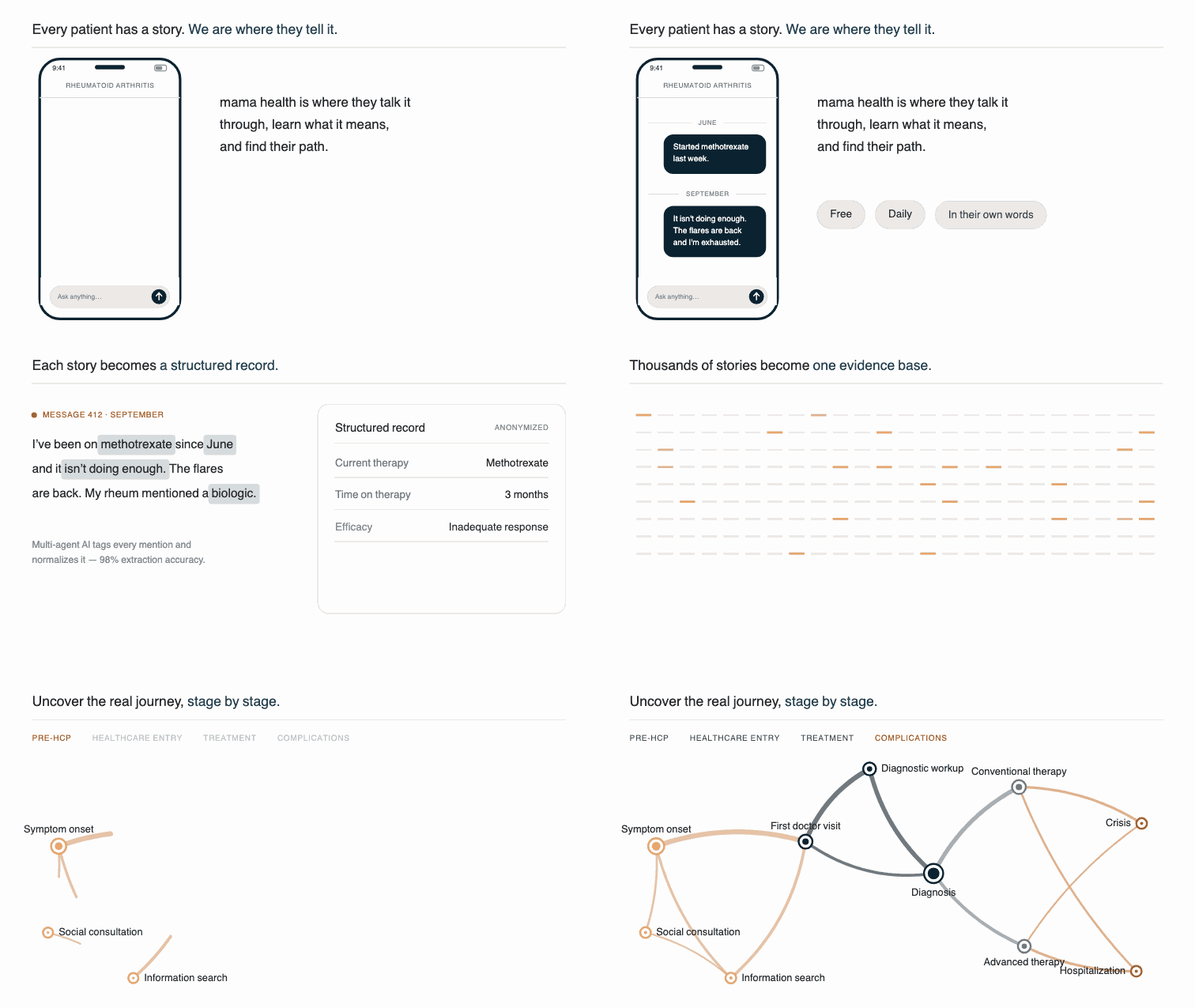
mama health ran AI-moderated conversations with patients and their caregivers. They covered which formulation patients are on, how reliably they take it, what gets in the way, what led to their last hospitalization, and what the caregiver absorbs.
The conversations adapt to each person. So the comparison the client needed came from the patients, rather than from a hypothesis written in advance.
Conversations were de-identified and aggregated into the Patient Journey Analytics Platform. The client's teams query the data there directly and pull it into their own materials.
Key insights
A 25-point adherence gap between two versions of the same molecule
Patients reported their own adherence, by regimen:
- Two pills a day: around 95.0% reported adherence
- Six pills a day: around 70.0% reported adherence
Both groups take the same molecule at the same daily dose. What changes is how many pills that dose takes.
Patients connect the missed dose to the hospital
One in four linked a hospitalization to poor adherence or an interruption in treatment. That's the part the payer never sees. The payer sees the admission.
The symptoms of the condition are what make the regimen hard to follow
Daytime sleepiness, trouble concentrating, forgetfulness and confusion were the symptoms patients described most often. Those are the same symptoms that make six pills a day hard to keep track of, and the drug is there to stop them getting worse.
The caregiver is running the medication schedule
Wives, daughters and brothers described looking after someone full time. One man described his wife simply as "my mother." Patients know it, and the guilt of being a burden comes up again and again.
Most patients are frightened, and a lot of them are alone with it
Patients described fear of getting worse and fear of another episode. They described staying home and going out "only when absolutely necessary." Many try to hide their diagnosis from the people around them.
Core insight
Fewer, more expensive pills are better for the patient and cheaper for the system. The simpler regimen holds adherence, and one in four patients say a missed or interrupted dose is what put them in the hospital.
The same thing happens anywhere a payer substitutes on molecular equivalence and the difference in burden never shows up in claims data.
Why it matters
For market access
The argument stopped being about unit price. Two versions of one molecule became a total cost of care question, where the cheaper line item produces the more expensive outcome. The client uses the data in its own institutional and payer conversations.
Adherence here is patient-reported, and patient-reported adherence tends to run high. That's why the finding that matters is the gap between the two groups, rather than either number on its own.
For patient advocacy
The patient's and the caregiver's experience is now a meaningful part of a conversation where, until now, only the price per pack was represented.
mama health is now the data provider for a public awareness campaign run with a national patient association. The campaign is aimed at the public and at institutions, with the goal of equitable access to the right formulation for everyone who needs it.