
The psoriasis launch opportunity hidden in treatment switching


What US patient treatment histories reveal about efficacy loss, advanced-therapy movement, and unmet demand for an effective oral therapy.
This report draws on mama health's ongoing patient conversation data across US psoriasis to show where patients move, why they leave a therapy, and what they say they still need. It is detail that does not show up in claims data, surveys, or published literature.
Scope. The aim is a practical one: to help the right therapy reach the right person at the right time, so that a treatment decision translates into a better daily life for the person living with psoriasis.
Two views into the same treatment journey
Key figures
- 3.6 avg therapies per patient
- 73% use 2+ therapies
- 40% stop for lost efficacy
- 32.4% oral patients, prior biologic use
In this report
01 · How patients move through treatment, and why most keep switching
556 treated patients · switching patterns, discontinuation reasons, advanced-therapy pathways
02 · The oral gap: patients want an effective pill
492 confirmed patients · oral systemic uptake, biologic crossover, unmet need
03 · Why this matters: how mama health helps
Turning switching patterns into a real-time, shared view for launch teams
04 · Closing takeaway
What the data implies for launch and brand teams
The cohort
556 treated patients with a confirmed clinician diagnosis, living across the continental United States.
Figure: relative patient concentration by state. Source: mama health patient conversation data.
How US psoriasis patients move through treatment, and why most of them keep switching
The average US psoriasis patient has been on 3.6 different therapies. mama health's data follows where they go next, and what keeps pushing them off the drug they are on.
Treatment for psoriasis in the US rarely follows a straight line. Across 556 treated patients with a confirmed clinician diagnosis, the average person has been on 3.6 therapies across 3 distinct classes. Only 27% started and stayed on a single treatment. A further 34.7% reached four or more lines, and 18.9% reached six or more. Switching is the norm, not the exception.
Biologics take a larger share of patients at each line
The opening picture is familiar. When patients first reach for something, it is almost always the tube of cream or the emollient by the sink, the everyday, low-stakes tools of psoriasis care. That is where the journey begins for most, and the data mirrors what dermatologists see in clinic every day.
Biologics are rare as a patient's first treatment, but they do not stay rare for long. With each new treatment line, more of the cohort ends up on one: by the third line, 23% of patients are on a biologic, making it the single most common option at that point. The pattern is simple. The longer psoriasis resists treatment, the more likely a biologic becomes the next step.
The routes in are strikingly varied. In the curated class-to-class switches, patients step up to biologics from almost every corner of the prior armamentarium: emollients, topical steroids, conventional systemics, the newer oral PDE4 and TYK2 agents, even phototherapy. Across these pairs, 9.4% of the cohort makes that move. No single prior pathway dominates. Instead, many roads converge on the same destination, which suggests biologics function less as the next step in a fixed sequence and more as a common landing point once the disease outgrows whatever came before.
Figure: pathways into biologics (class-to-class switches)
Patients moved into biologics from emollients, topical steroids, conventional systemics, oral PDE4 or TYK2 agents, and phototherapy. Across these pairs, 9.4% of the cohort made that move.
Taken together, this is the clearest treatment-pattern shift the analysis records: not a sudden switch, but a steady handover of ground, line by line, from the topical and conventional world to the biologic one.
Patients switch when a drug stops working
For most of the 556 patients in this cohort, treatments do not end with a decision so much as with a slow disappointment. Lost efficacy is the single largest reason a therapy is stopped, at 40% of recorded stops, and in mama health's ongoing conversations that number takes on a very particular shape.
Patients describe biologics they once trusted quietly beginning to fade: Skyrizi wearing off in the days before the next injection, Cosentyx losing its grip after months of clear skin, Humira no longer holding the line it used to hold. Several describe cycling through four or more biologics, of "running out of options," of the sense that nothing works anymore. The emotional register is rarely dramatic. It is the language of erosion. A drug that worked becomes a drug that used to work, and the search begins again, this time with less optimism than the last.
Beneath that clinical story runs a distinctly American one. Alongside efficacy, patients talk about coverage that changed, prior authorizations that lapsed, and out-of-pocket costs they could no longer absorb. In their accounts, discontinuation often is not a clinical decision at all. It is an administrative one, forced on them from outside the exam room, and it frequently ends in a severe rebound flare that undoes months of progress. Many describe feeling that their dermatologist is genuinely trying, but is disconnected from what they can actually get and afford.
Biologics get dropped the most
The irony of the psoriasis pathway is that the therapies patients climb hardest toward are also the ones they most often fall away from. Among therapy classes, monoclonal-antibody biologics carry the highest recorded stop rate of any advanced therapy, at 56.1% of starters. Reaching an advanced therapy is, for many, not the end of the journey but the middle of it.
In patients' own words, this is where fatigue with the system sets in most sharply. They describe biologics as the treatments they waited longest for, fought insurance hardest to reach, and, for a stretch of time, genuinely believed in. When those drugs wane, or a plan change pulls one out from under them, the loss feels disproportionate: patients speak of joint pain returning, skin flaring back within weeks, and quality of life, work, and self-esteem all suffering once an effective therapy is withdrawn.
What emerges is less a story about any one drug failing and more a story about the shape of the advanced-therapy experience itself: a long climb, a period of relief, and then, for a majority, another switch, driven by biology, by side effects, or by the system. Patients name the unmet need directly. They want therapies that hold, and access that holds with them.
Where the advanced-therapy switches go
Within advanced therapy the recorded drug pairs are small but consistent in direction. Methotrexate is the most common springboard, usually into adalimumab. From methotrexate, adalimumab, and apremilast, patients move into the IL-17 and IL-23 agents: secukinumab, risankizumab, and guselkumab.
Figure: advanced-therapy switch pairs
- Methotrexate to adalimumab, the most common springboard
- Apremilast to secukinumab
- Apremilast to risankizumab
- Adalimumab to guselkumab
- Ustekinumab to guselkumab
Guselkumab is the most repeated destination across these switches.
A closer look at one IL-23 brand
Behind the brand names, two very different patient stories are unfolding in the IL-23 class, and Tremfya's is the quieter, stranger one.
Patients who reach Tremfya often arrive there weary. In conversations with mama health, they describe cycling through Cosentyx, Humira, Taltz and Otezla, a familiar litany of near-misses, partial responses, and hopes that did not hold. What sets Tremfya apart in these journeys is not drama but stillness. Those who respond describe stable skin, an every-eight-weeks rhythm that fits into life rather than interrupting it, and, for some, a first real reprieve from years of failed biologics. One patient called it their first successful biologic. Another spoke of skin finally clearing after a long chain of disappointments. When people do leave Tremfya in this data, they rarely say the drug stopped working. The exit door is insurance, not the medicine itself. Just 10% stopped, and every recorded reason was coverage-related. In a category defined by attrition, Tremfya is the only brand with meaningful exposure showing no clinical discontinuation at all, a quiet signal that, for those who reach it, the drug tends to earn its place.
Skyrizi's story is louder, and more turbulent. Patients describe it in superlatives: the fastest clearance they have seen, the most effective thing they have tried, the treatment they would fight to get back after a lapse. The same voices also describe the flip side: efficacy that fades after a year or wanes between doses, injection-site irritation, and the exhausting choreography of insurance changes, financial-assistance paperwork, and out-of-pocket bills that force people off a drug that was working. When Skyrizi stops, flares often come back hard. That volatility shows up in the numbers too, at 45.5% discontinuation over the same window, spread across efficacy, insurance, cost, and reasons never captured.
Figure: discontinuation rate over the same window
- Tremfya, 10% of starters
- Skyrizi, 45.5% of starters, over four times the Tremfya rate
And yet reach is where the story turns. Skyrizi is the drug patients talk about, fight for, and are prescribed most. Tremfya is the one a smaller group quietly stays on. Among the patients in this data using an IL-23 agent, 68.8% are on Skyrizi and 31.3% are on Tremfya. Across the wider biologic market Tremfya ranks fourth, used by 11% of patients on a biologic, behind Skyrizi (24.2%), Humira (19.8%), and Cosentyx (12.1%). The commercial picture, in other words, is almost the mirror image of the experiential one. The brand with the noisier discontinuation profile reaches the most patients, while the brand whose patients rarely leave for clinical reasons remains a challenger.
Access sends patients backward
Cost and insurance do not only end treatments in this data, they reverse them. Patients describe Medicaid denials of Cosentyx, coverage of Humira lost with a job change, and Otezla dropped when an assistance program ended, each one pushing them back to topicals they had already failed.
What the analysis concludes
Movement between therapies is structural. 73% of treated patients use two or more therapies, biologics triple their share of patients between the first and third line, and lost efficacy rather than tolerability is the leading exit. The implication for launch and brand teams: anticipate switch-in from conventional systemics and orals into the IL-17 and IL-23 classes, and pair durability messaging with US-specific access support.
The oral gap in psoriasis: patients want an effective pill, and a third have already tried the injection
The leading oral pill for psoriasis draws a familiar arc of early hope and slow disappointment. mama health's data shows who is taking it, and the gap they keep describing.
Ask patients with psoriasis what they want from a treatment and the answer is remarkably consistent: skin that clears, a drug that does not punish them for taking it, and a route to it that does not require a fight with an insurer. They tell mama health this in their own words, again and again. The US oral market, as it stands, meets that wish list only in fragments.
Why patients reach for a pill in the first place
The appeal of an oral is easy to hear in the conversations. For some it is needle phobia, the quiet dread of a self-injection that never quite goes away. For others it is the pull of something that feels ordinary: a tablet on the counter, no sharps container, no cold chain, no ritual. Several describe topicals as messy and time-consuming, and biologics as a commitment they were not ready to make. A pill offers a sense of autonomy, a treatment that fits into a life rather than reshaping one.
That appeal plays out against a narrow field. Across 492 confirmed patients, the oral category rests almost entirely on Otezla, at 6.9% of the cohort, with the only other approved option, Sotyktu, trailing at 0.8%.
Figure: oral systemic uptake, 492 confirmed patients
Drawn from 14,760 AI interview hours. Otezla accounts for 6.9% of confirmed oral patients and Sotyktu for 0.8%, across two approved oral options.
The leading oral gets mixed marks
That autonomy is where the story starts to sour. Patients on Otezla describe a familiar arc: early hope, then a slow realization that the skin is not really clearing, or that it cleared for a while and then did not. When patients do come off it in this data, tolerability leads the reasons, and the conversations tell you why. Gastrointestinal side effects come up repeatedly: nausea that lingers, stomach upset that makes the pill hard to keep taking, a trade-off many are unwilling to sustain for a partial response.
Others describe access friction that has nothing to do with the drug itself: specialty-pharmacy handoffs, copay-program cliffs, and coverage that changes with a new plan year and leaves them without medication for weeks.
A third of oral patients have also been on a biologic
The most telling finding is who these oral patients actually are. Nearly a third, 32.4%, have already been on a biologic. These are not people who chose the pill to avoid advanced therapy. They have been through the injectable, moved past it, and landed on an oral for reasons of their own: side effects that pushed them off, response that faded, cost or coverage that changed, or a decision that the injection simply was not sustainable.
Figure: prior biologic use among oral patients, 32.4%.
Whatever brought each of them here, the bar these patients set is a high one. Any oral aiming at this group has to work for people who already know what a biologic feels like, and, for many, what it feels like when a biologic stops working.
What patients say they want
Sit inside the conversations for any length of time and the wish list writes itself. Patients want an oral that actually clears the skin and keeps it clear, something that behaves like remission rather than a partial response that fades. They want it without the nausea. They want, where relevant, benefit for the joints too, not just the plaques. And they want honesty from clinicians and manufacturers about what the drug is likely to do for someone like them, and how long it is likely to keep doing it.
Around all of that sits a plea for a smoother path to the medicine: fewer specialty-pharmacy hurdles, less insurance choreography, and fewer treatment gaps caused by administrative churn rather than clinical decisions.
Figure: patient frustrations vs. stated needs
Most common frustrations: incomplete clearance, tolerability, injection burden, insurance and cost.What patients want: consistent efficacy, minimal side effects, easy access, joint relief.
The gap is defined, not hypothetical
None of these frustrations is dramatic on its own. Together, and set against a leading oral that patients often describe as not clearing them, they map the distance between what patients want from a pill and what today's pills deliver.
The size of the opportunity comes straight from the data: 6.9% of the cohort already on an oral, 32.4% of them carrying prior biologic experience, and a steady flow of newly diagnosed moderate-to-severe patients weighing an oral that may not fully clear their skin against an injectable many of them describe as a burden. The market for an effective, well-tolerated, accessible pill is not theoretical here. It is already in the room, and it is already articulate about what it wants.
From switching patterns to launch decisions: how mama health helps
The findings in this report exist because mama health tracks how patients actually move through treatment, not just where they end up.
Most commercial teams learn about a switching pattern like the ones in this report only after claims data catches up, often a quarter or more after patients have already moved on. mama health closes that gap by turning ongoing patient conversations into a continuously updated view of who is switching, why, and where they land next.
A real-time view of the switching moment
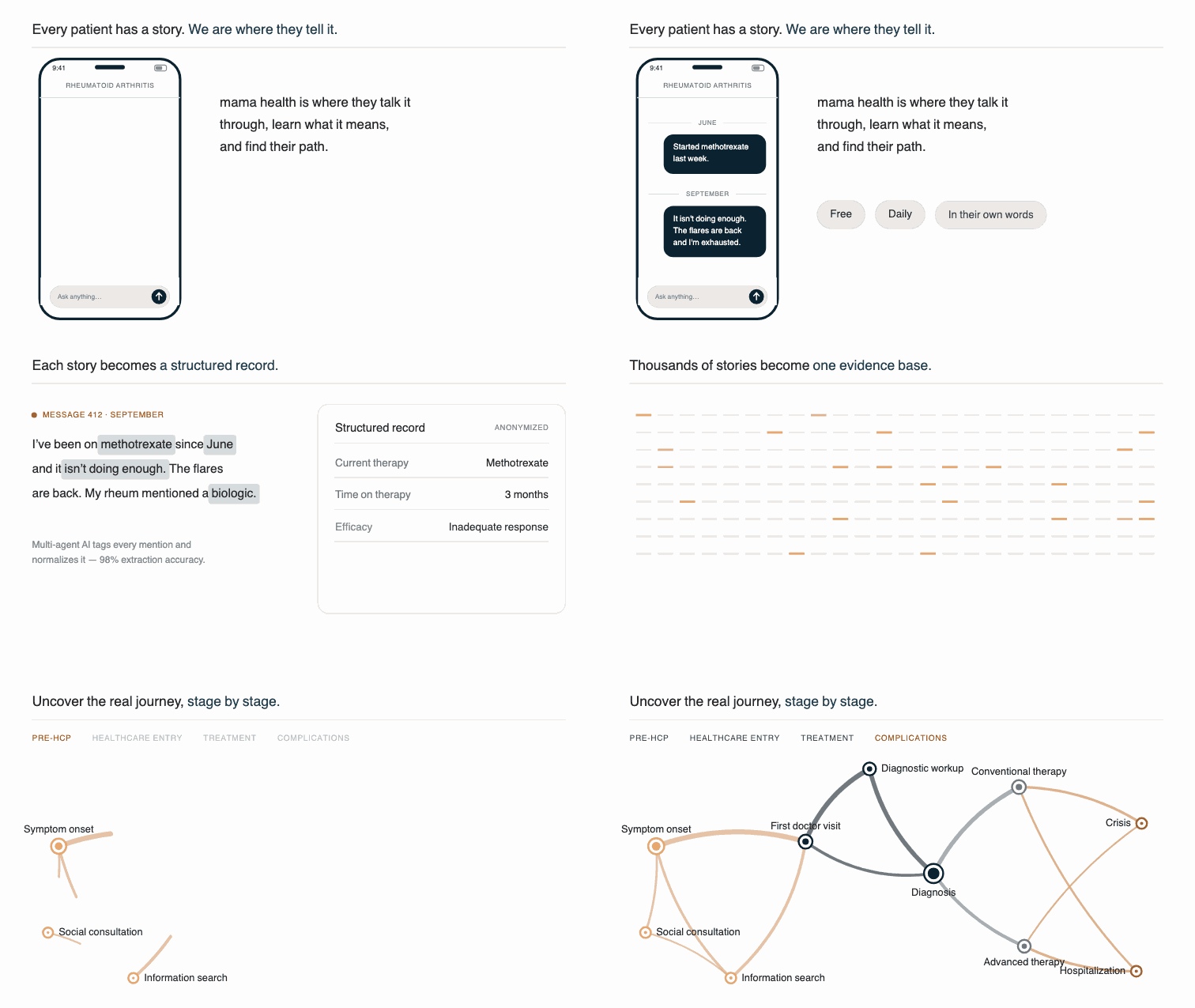
Traditional research captures a single snapshot of the patient journey, already dated by the time it is analyzed. mama health replaces that snapshot with a continuously evolving view built from thousands of real patient conversations, so a shift between treatment classes, or a patient losing response to an advanced therapy, surfaces as it happens rather than a quarter later.
Figure: the mama health platform, Patient Journey Explorer, US psoriasis. Source: mama health platform.
One shared view for commercial, access, and medical
Switching decisions touch several functions at once. Commercial needs to know which brand is gaining ground, market access needs to understand the insurance and cost stops that reverse treatment, and medical affairs needs to see where tolerability is driving discontinuation. mama health gives every function the same real-time patient view, so a launch plan reflects one shared reality instead of three different guesses.
From patient signal to launch decision
Because the view updates continuously, a pattern shows up while a launch team can still act on it: a therapy beginning to lose efficacy, a new route opening up between treatment classes, or a coverage denial sending a patient back to topicals. In a category shaped as much by switching as by any single drug, that timing is the difference between planning around what patients are doing now and planning around where they were a quarter ago.
Closing takeaway: an oral that actually clears skin would not enter an empty category
An oral therapy delivering stronger, more consistent efficacy while keeping the convenience of a pill would be answering a gap these patients have already described in their own treatment histories.
Based on 556 treated patients, 492 confirmed diagnoses and verbatim patient journeys, US psoriasis, 2026.
mama health is not affiliated with, endorsed by, or sponsored by any pharmaceutical manufacturer. The brand and product names in this report remain the property of their respective owners and appear here only as patients reported them when describing their own treatment histories.