Adverse event reporting from real-world patient conversations

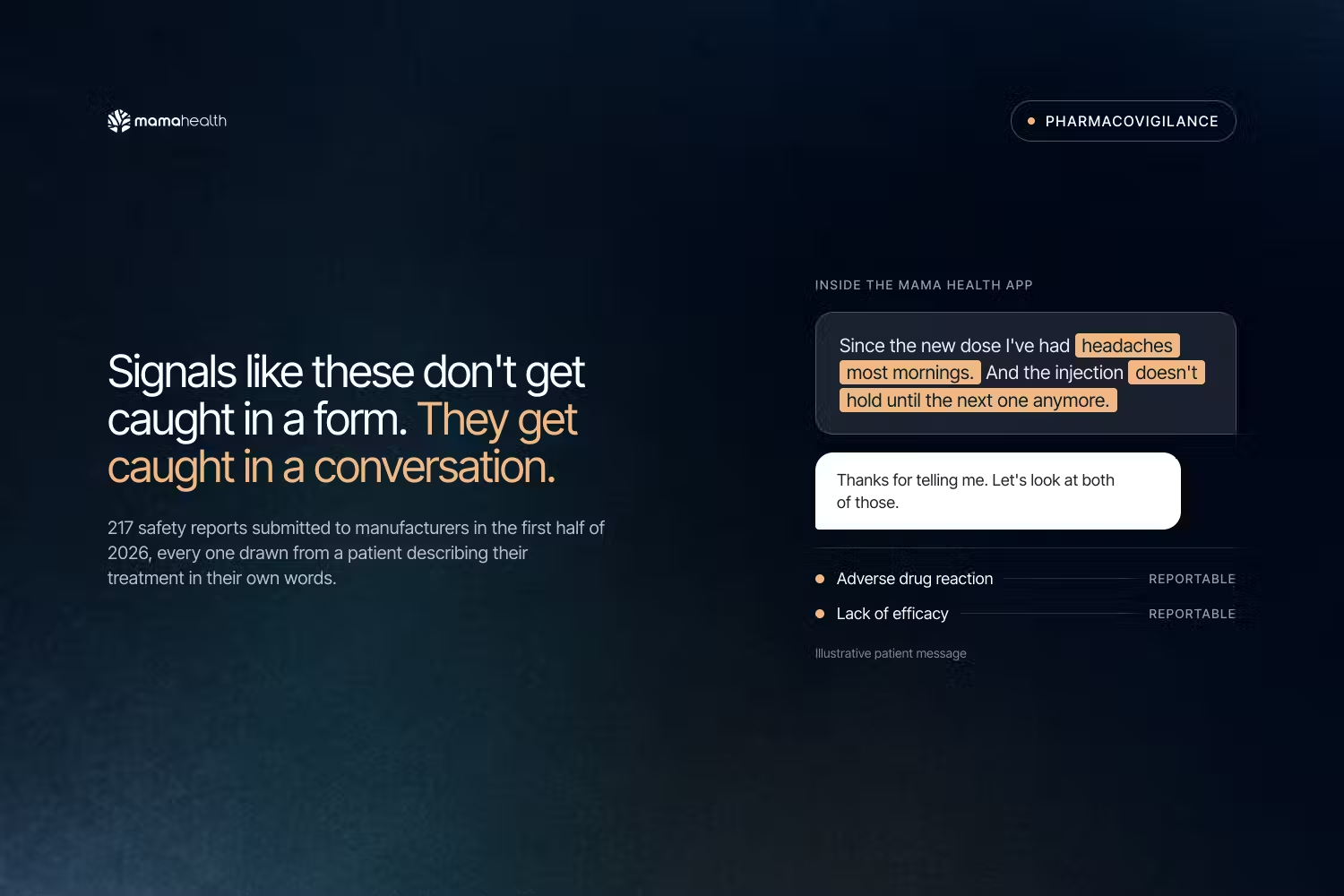
In the first half of 2026, mama health voluntarily submitted 217 safety reports to pharmaceutical manufacturers, roughly five times the volume sent in all of 2025. Every one originated as an unsolicited report drawn not from a call center or a clinical trial, but from a patient describing their treatment, in their own words, inside the mama health app.
For pharmacovigilance and medical affairs teams, that source is the point. Spontaneous adverse event reporting has always depended on the patient recognizing a reportable experience and acting on it, and that dependency is precisely where real-world safety data is lost.
The underreporting problem
Spontaneous reporting is the backbone of post-marketing safety surveillance, and under-reporting is its long-standing limitation. A systematic review of 37 studies across 12 countries put the median under-reporting rate for adverse drug reactions to spontaneous systems at roughly 94%, and found the shortfall remained substantial even for serious or severe reactions. The reasons are structural rather than clinical, because reviews of what drives under-reporting point consistently to knowledge and attitude over clinical difficulty, including a widespread assumption that only severe reactions are worth reporting. For patients, who sit even further from the reporting infrastructure than clinicians do, those same barriers are amplified, and much of what they experience is never judged dramatic enough to submit, even when it carries genuine signal value.
The consequence is a benefit-risk picture, and a signal detection process, built on a fraction of what patients actually experience. In complex, long-term conditions, where treatment plays out over years and much of the relevant information is qualitative, that gap is widest.
How the workflow works
mama health approaches the problem from the point where the data already exists, because patients use the mama health app to understand their condition and their treatment, describing symptoms, tolerability, and how their medicines are performing over time in natural language rather than a structured safety form. A reportable event is frequently already contained in that conversation, and the work is identifying it.
mama health's clinical team reviews what surfaces, applies pharmacovigilance criteria to determine whether an event is reportable, and escalates qualifying cases; each is then submitted to the relevant manufacturer through that company's designated pharmacovigilance channels, in the required case-report format and within its timelines, where it enters the marketing authorization holder's safety database as an individual case safety report.
The effect is to convert reporting from a patient-initiated action, which most patients never take, into a consistent output of a conversation the patient was already having.
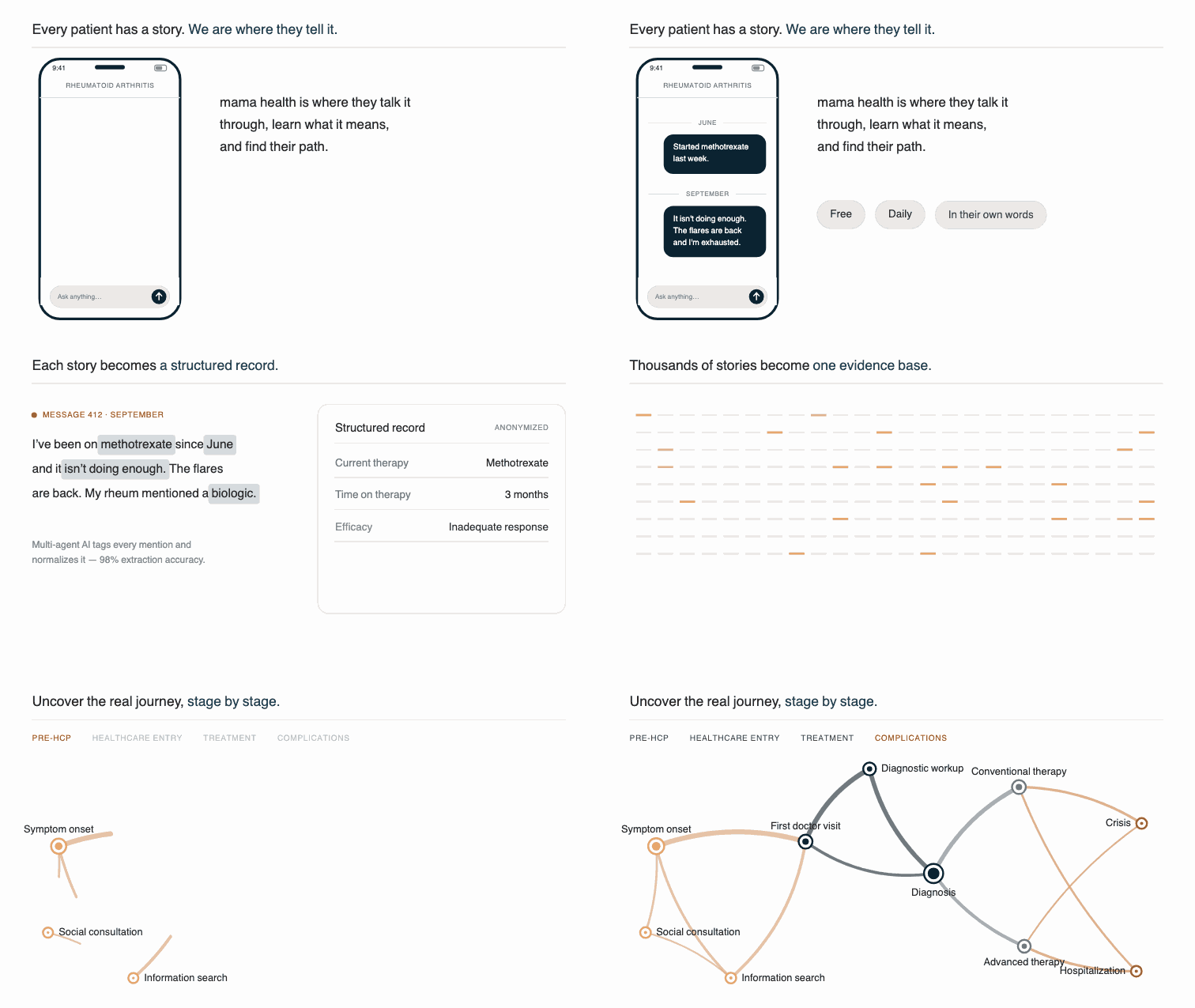
Adverse drug reactions and lack of efficacy
Two signal types account for the bulk of what mama health reports. The first is the adverse drug reaction, the category around which classical pharmacovigilance is organized. The second is the one conventional channels capture least well: lack of efficacy, meaning a treatment that has stopped working or that a patient has quietly discontinued because it was not helping. In mama health's experience a therapy failing to perform rarely prompts a spontaneous report, since it does not present as an acute safety emergency, yet it emerges readily in conversation when a patient describes the reality of their week.
For real-world evidence, that second category is significant, because a safety and effectiveness picture assembled only from reported adverse reactions is partial, and how a medicine performs in routine use, including the moments it fails, is as much a signal as any side effect.
Where the 2026 signals came from
The 217 reports span the full range of complex, long-term conditions, the areas where treatment extends over years and daily patient experience carries the most weight.
By therapeutic area:
→ Immunology and rheumatology: 51
→ Neurology: 45
→ Gastroenterology: 37
→ Dermatology: 21
→ Respiratory: 14
→ Oncology: 12
→ Cardiology: 12
→ Metabolic and endocrine: 9
→ Nephrology: 5
→ Other chronic and rare conditions: 11
The reports reached manufacturers across 16 countries, led by Italy, the United States, France, Germany and Poland, and extending across Europe alongside Canada, Japan and Singapore. In total, they reached 120 distinct manufacturer safety desks at more than 60 pharmaceutical companies.
Why this matters
For a safety team, a signal that arrives is worth more than the many that never do, since each report is a unit of real-world evidence on how a product behaves outside controlled trial conditions, among the patients who actually take it. Patient-sourced reporting reaches the cases the spontaneous system is structured to miss: the adverse reaction a patient never thought to submit, the treatment that failed quietly, and the experience that becomes visible only when someone is describing their life rather than completing a form. In complex, long-term conditions, that is not a marginal supplement to post-marketing surveillance but may be the portion that was absent.
A workflow, not a strategy
Signals like these do not get caught in a form. They get caught in a conversation.
Every one of the 217 reports was voluntarily submitted by mama health through established pharmacovigilance channels. The industry often describes putting patients first as a strategy, but at mama health it is a workflow: a clinical team, an escalation process, running every day.