.avif)
Life science companies do not fail because they lack data.
They have market research. They have claims data. They have advisory boards. They have forecast models, segmentation studies, patient panels, social listening, prescribing data, payer research, and launch readiness frameworks.
And yet, launch underperformance remains one of the industry’s most expensive problems. McKinsey has reported that in markets where multiple comparable therapies are available, 60% of launches fail to meet prelaunch expectations. Health Advances has estimated that companies can spend hundreds of millions of dollars across the years immediately before and after a product launch.
That should make the industry uncomfortable.
Because the problem is not always the molecule. It is not always the clinical profile. And it is not always the market.
Often, the problem is that launch teams do not understand the patient reality deeply enough, early enough, or continuously enough to act before launch performance starts to slip. This is the central argument behind mama health’s analysis on why 60% of commercial drug launches fail and how to avoid common launch mistakes.
At mama health, we see this gap every day. Across 50,000 patients living with chronic and rare conditions, patients reveal the messy, emotional, practical, and often invisible barriers that traditional research methods struggle to capture. These are not neat survey responses. They are not retrospective claims codes. They are real-world conversations about symptoms, delays, fears, treatment decisions, side effects, access barriers, daily-life impact, and what it actually takes to start and stay on therapy.
Panels, surveys, and claims databases all have value. But they also have limits.
Panels often show what patients say when asked a specific question.
Surveys show what patients can remember, simplify, or quantify.
Claims data shows what happened after a decision was already made.
Patient conversations reveal why it happened in the first place.
Here are 10 things 50,000 mama health patients revealed that no panel, survey, or claims database ever captured.
1. The patient journey does not start where life science teams think it starts
Many launch plans begin the patient journey at diagnosis, prescription, or treatment initiation.
Patients rarely experience it that way.
For patients, the journey often starts months or years earlier: with symptoms they cannot explain, appointments that do not lead to answers, referrals that never happen, or repeated moments of being told to “wait and see.”
That matters because diagnosis friction directly affects launch potential. If patients are not identified, referred, diagnosed, or escalated at the right time, even a clinically strong therapy may struggle to reach the eligible population.
This is especially important in rare diseases, autoimmune conditions, neurology, and other areas where diagnosis delays are common. In its coverage of Indegene’s product launch success research, Pharmaceutical Executive reported that manufacturers need to understand the patient journey, including the path to diagnosis, reimbursement scenarios, and physician-referral dynamics, to successfully reach the desired patient population.
Traditional journey maps often compress this stage into a clean box called “diagnosis.”
Patients describe it as uncertainty, exhaustion, dismissal, fear, and time lost.
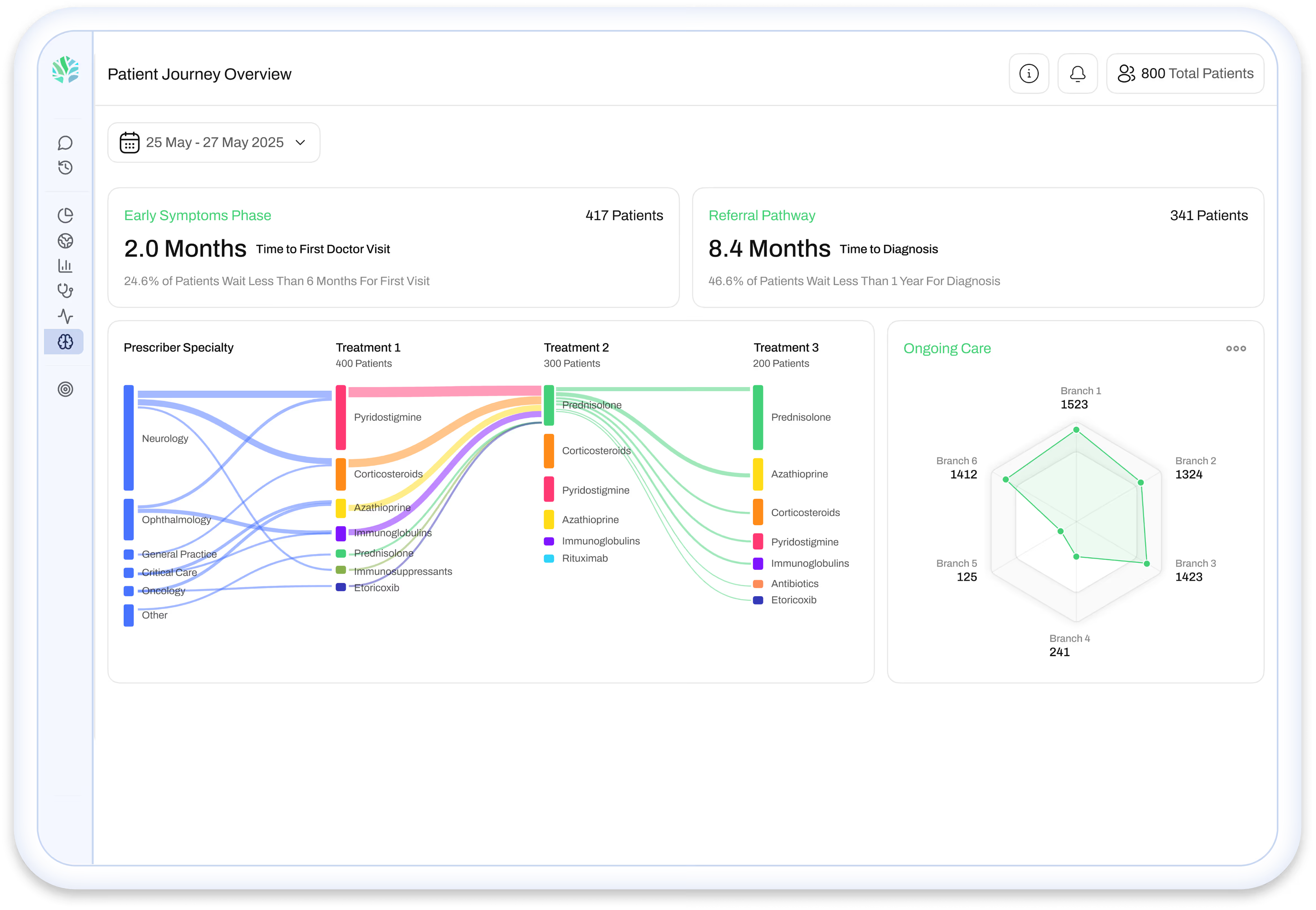
That is why real-world patient journey mapping matters. It helps life science teams see the full journey from first symptoms to diagnosis, treatment, and long-term management — not just the moments that are easiest to measure.
2. Access barriers are not just payer barriers. They are patient behavior barriers
Market access is one of the most cited reasons drug launches fail. Pharmaceutical Executive’s summary of Indegene’s research reported that 93% of experts identified payer activation and reimbursement challenges as having the greatest impact on product launch success.
But from the patient perspective, “access” is not a policy term. It is lived friction.
It is the moment a patient leaves the doctor’s office with a prescription but does not understand what happens next.
It is the prior authorization delay that turns excitement into doubt.
It is the copay that makes a patient hesitate.
It is the pharmacy call that never comes.
It is the form, the scan, the referral, the infusion appointment, the reimbursement letter, the transportation issue, or the sense that the system is too complicated to navigate.
The PCSK9 inhibitor launches are a clear example of how access friction can slow adoption. BioPharma Dive reported that Repatha and Praluent faced unexpectedly slow uptake after launch, with payer restrictions, prior authorization requirements, high annual prices, and limited outcomes data all contributing to hesitation among payers and physicians.
Claims data may eventually show that a patient did not fill, start, or continue treatment. But by then, the launch team is already reacting to a drop-off that began much earlier.
Patient conversations expose access barriers as they are forming — before they become lost starts, poor adherence, or disappointing uptake. This is also visible in mama health’s psoriasis analysis on the gap between access and outcome across Germany and the US, where similar treatment categories can produce very different patient realities depending on market context, expectations, and lived experience.
3. Patients hesitate for reasons launch teams often underestimate
Launch plans often assume that if a treatment is clinically effective, patients will want it.
Patients are more complex than that.
They may hesitate because they fear side effects. Because they do not feel “sick enough.” Because they have had bad experiences with previous treatments. Because they do not trust new therapies yet. Because they are overwhelmed by monitoring requirements. Because they do not want to disrupt work, family, fertility planning, travel, caregiving, or daily routines.
A patient may understand the clinical benefit and still not feel emotionally ready to start.
McKinsey has argued that effective launch leaders need both quantitative data and qualitative insight to understand multistakeholder journeys and shape launch decisions. That matters because the gap between awareness and action is often emotional, not just informational.
Surveys can ask whether patients are willing to try a therapy. Claims data can show whether they did. But real conversations reveal the emotional logic between the two.
For launch teams, that emotional logic matters.
It shapes messaging. It shapes patient support. It shapes HCP education. It shapes adherence planning. And it often determines whether a therapy becomes part of a patient’s life or remains a theoretical option.
This is why the shift toward real-time patient insights in life science strategy is becoming so important. Teams need to understand what patients are experiencing as decisions are being made, not months later when the research cycle closes.
4. Side effects are not just tolerability issues. They are launch risks
In clinical and commercial planning, side effects are often treated as label information, medical education topics, or adherence considerations.
Patients experience them as daily-life disruptions.
A side effect can affect confidence, intimacy, sleep, work, social life, mobility, independence, and trust in the treatment itself. When patients are not prepared for what a therapy may feel like in real life, discontinuation risk rises.
The launch of Nerlynx in HER2+ breast cancer is a well-known example of this dynamic. Fierce Pharma reported that Nerlynx’s lower-than-expected Q1 sales were linked to increased patient discontinuations, with executives acknowledging discontinuation as an important driver of the product’s commercial challenge.
The lesson is not simply that side effects need to be managed.
The lesson is that the post-prescription patient journey must be designed before launch. Patients need expectation-setting, practical guidance, reassurance, escalation pathways, and support that reflects how treatment feels outside the trial environment.
Patient conversations reveal where side effects become fear, where fear becomes hesitation, and where hesitation becomes discontinuation.
5. Patients do not describe value the way life science teams do
Life science teams often define value through clinical endpoints, efficacy, safety, durability, health economics, and differentiation versus standard of care.
Patients speak about value differently.
They talk about being able to work again.
Sleeping through the night.
Feeling less afraid of a flare.
Not canceling plans.
Being able to pick up their child.
Reducing the number of unpredictable days.
Spending less time managing the healthcare system.
Feeling believed.
Feeling in control.
This does not replace clinical evidence. But it does reveal what clinical benefit means in real life.
Deloitte’s work on drug launch strategy emphasizes the importance of understanding unmet customer needs, behaviors, stakeholder perspectives, and differentiated value propositions across patients, caregivers, physicians, payers, and institutional buyers. That is exactly where patient conversations create commercial value: they translate evidence into lived relevance.
A therapy’s value story is weaker when it only speaks the language of the manufacturer, payer, or physician. It becomes stronger when it connects evidence to the outcomes patients actually recognize in their daily lives.
This is especially important in crowded markets, where clinical differentiation may be incremental but patient-perceived differentiation can still be meaningful.


6. The patient journey is not linear
Many patient journey maps look like this:
Symptoms → Diagnosis → Treatment → Adherence → Outcomes.
Patients rarely move in a straight line.
They move forward, backward, sideways, and sometimes out of the system entirely. They seek second opinions. They pause treatment. They switch physicians. They delay starting therapy. They abandon prescriptions. They restart after a flare. They turn to communities. They compare experiences with other patients. They change their minds based on side effects, cost, emotional readiness, or trust.
Static journey maps make this look organized.
Patient conversations show the real journey: fragmented, iterative, emotional, and shaped by moments that may never appear in a claims database.
The launch of Aduhelm showed how multiple journey barriers can compound at once. Business Insider reported that six months after approval, Aduhelm had generated only $3.3 million in sales despite major expectations. A later US congressional staff report documented broader concerns around the drug’s approval, pricing, and launch planning.
For launch teams, this matters because intervention points are often missed when the journey is oversimplified. A brand may invest heavily at prescription but ignore the moments before and after that determine whether the patient actually starts and stays on therapy.
A real patient journey is not a slide.
It is a moving system.
7. Patients reveal messaging gaps before performance data does
One of the most dangerous launch risks is a message that sounds strong internally but does not land externally.
Patients expose this quickly.
They reveal when a message is confusing, too clinical, too abstract, too optimistic, too frightening, or disconnected from what they actually care about.
They reveal misconceptions that need to be corrected.
They reveal unmet expectations that need to be managed.
They reveal language that resonates and language that creates distance.
This matters because weak differentiation and poor positioning are recurring drivers of launch underperformance. In crowded markets, physicians and payers often default to the status quo unless a new therapy’s value is clear, credible, and relevant.
McKinsey has described the need for launch leaders to “find the edge” by building compelling narratives that address clinical, health-economic, and stakeholder-experience considerations. The same principle applies to patient communication: the strongest message is not the one that says the most. It is the one that makes the value of the therapy immediately meaningful to the person living with the condition.
Patient conversations help teams sharpen that value story. Not by replacing clinical messaging, but by grounding it in the lived outcomes, concerns, and trade-offs that influence real decisions.
That is why patient insight platforms are increasingly becoming part of launch planning. mama health’s overview of top patient insights tools for commercial drug launches explains how qualitative patient insight can help teams shape messaging, identify emotional drivers, and align strategy around the real patient voice.
8. Internal teams often operate from different versions of the patient truth
Launch failure is rarely caused by one team.
It often happens when commercial, medical, market access, HEOR, insights, patient advocacy, and field teams each work from different assumptions.
One team may focus on payer restrictions.
Another may focus on HCP education.
Another may focus on adherence.
Another may believe the biggest barrier is awareness.
Another may believe the problem is differentiation.
All of them may be partly right. But if they are not working from the same patient reality, the launch strategy becomes fragmented.
Deloitte has specifically called out the need to break down internal silos, ensure cross-functional input around market needs, and align functional and enterprise goals. McKinsey has similarly argued that launch teams need to connect the dots across stakeholder journeys and build a cross-functional market perspective.
Patient conversations create a shared evidence base. They show every function where patients are struggling, what they misunderstand, what prevents action, what support they need, and where the journey is breaking down.
When every team sees the same patient truth, decisions become faster, clearer, and more coherent.
This is also where real-world evidence and patient experience data are converging. In mama health’s article on best RWE companies for patient insights, the shift is clear: life science teams need evidence that reflects not only healthcare utilization, but lived experience, unmet needs, and evolving perceptions.
9. Launch risks appear in patient conversations before they appear in dashboards
Launch dashboards are essential. But many of them are lagging indicators.
They show what already happened: prescriptions, starts, fulfillment rates, discontinuation, market share, claims activity, or HCP engagement.
Patient conversations can reveal signals earlier.
Patients may start expressing confusion about a therapy before initiation rates decline.
They may discuss side effect anxiety before discontinuation rises.
They may describe access frustration before abandonment appears in the data.
They may question the value of switching before HCPs report resistance.
They may reveal emotional or practical barriers that never become structured data at all.
McKinsey has warned against relying only on third-party monthly reports and has described the value of launch situation rooms that help teams speed decision-making and execution. The underlying principle is clear: launch teams need feedback loops that are fast enough to act on.
This is why real-time patient insight matters. Modern launches move too quickly for research cycles that close after the moment to act has passed. Markets shift, competitors move, payers push back, and patient expectations evolve continuously.
As mama health explains in its article on how real-time patient insights are changing life science strategy, the advantage comes from moving beyond static, delayed patient input toward continuous patient understanding.
A launch team that waits for quarterly research may discover the problem only after the first six months have already shaped the brand’s trajectory.
10. Patients reveal that launch excellence is not just about launch
The biggest insight from 50,000 patients is simple:
Launch success is not created at launch.
It is created before launch, through a deeper understanding of the patient journey.
It is created when teams know where diagnosis breaks down.
When they understand why patients hesitate.
When they anticipate access friction.
When they prepare for side effect concerns.
When they build support around real-life barriers.
When they align every function around the same patient reality.
When they keep learning after launch instead of relying on a static research snapshot.
Deloitte’s 2023 analysis argues that modern drug launches require more resources, deeper clinical expertise, better cross-functional coordination, and greater agility. But agility is only useful if teams know what to respond to.
That is the role of patient intelligence.
It gives teams visibility into the real patient experience before launch, during launch, and after launch. It helps them understand what patients are saying, where they are getting stuck, what they need, what they fear, and what support could change the trajectory.
This is the shift life science teams need to make.
From episodic research to continuous insight.
From static journey maps to real-time patient intelligence.
From assumptions about patients to conversations with them.
From waiting for performance data to reveal a problem to detecting patient signals early enough to act.
The 60% launch failure problem will not be solved by more data alone. Life science companies already have data.
It will be solved by better understanding the human reality behind the data.
That is what 50,000 mama health patients make visible.
And it is what panels, surveys, and claims databases were never designed to fully capture.
Conclusion: The future of launch planning is patient-led
Commercial launch excellence has always required strong market access, stakeholder alignment, differentiated positioning, and agile execution.
But in today’s market, those capabilities are not enough unless they are grounded in real patient experience.
The brands that win will be the ones that understand patients before the market reacts. The ones that see hesitation before it becomes poor uptake. The ones that identify support needs before they become discontinuation. The ones that align teams around what patients are actually living, not what internal teams assume.
At mama health, we believe patient intelligence is becoming a launch-critical capability.
Because patients are already telling the industry what is working, what is breaking, and what they need next.
The question is whether launch teams are listening early enough.