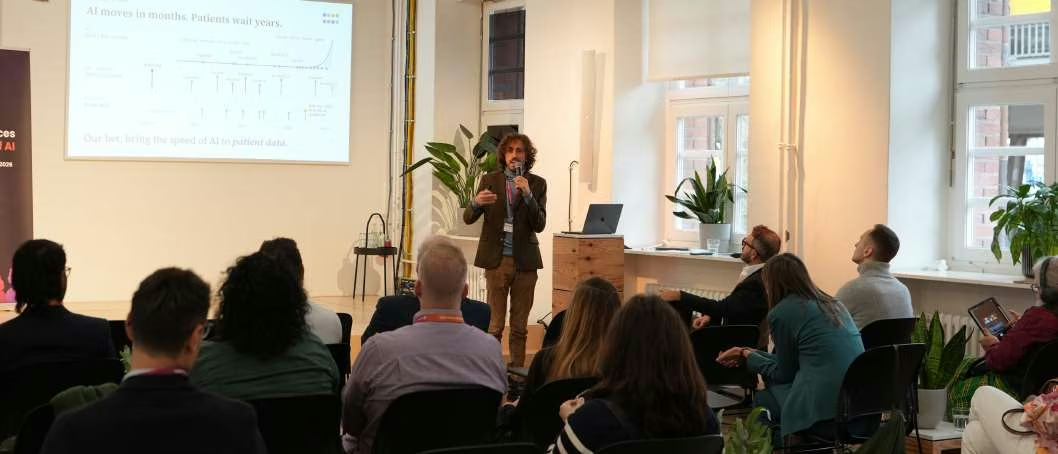
Perspectives from European patient advocates on trust, access, and meaningful involvement in shaping AI.




 and more
For someone living with a chronic or rare disease, an unanswered question can stay with them long after an appointment ends. AI offers another place to turn, sometimes when people feel worried, unheard, or unsure what to do next.
At the Patient Voice Forum, participants welcomed its potential while asking who takes responsibility when an answer is misleading, whose needs might be overlooked, and how patients can help shape the tools they use. Five priorities emerged:
Tell us who you are and the rest of the findings open on this page.
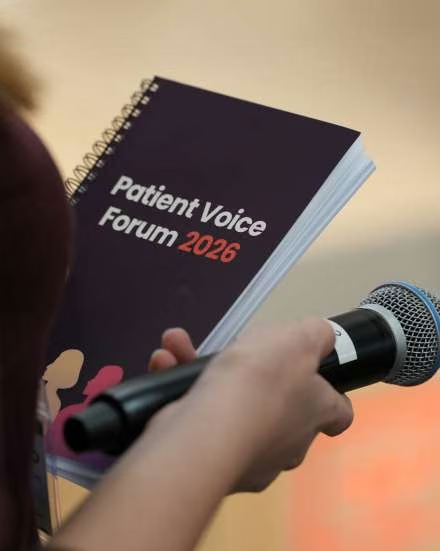
Held on October 24, 2026, the Patient Voice Forum brought together patient advocates and association leaders from across Europe, representing people living with endometriosis, prostate cancer, lung cancer, and other rare and chronic diseases.
Morning talks informed small-group discussions about AI’s opportunities, limits, and responsibilities.
This paper draws mainly on those discussions and reflects the perspectives shared in the room, rather than a formal consensus or systematic assessment of the evidence.
Participants’ optimism was grounded in familiar frustrations: years spent looking for a diagnosis, appointments that feel too short, and questions that arise when nobody is available to answer them. They saw three areas where AI could make a meaningful difference.
The diagnostic journeys participants described for endometriosis, often beginning in adolescence.
Endometriosis became a recurring example. Participants described diagnostic journeys lasting up to 10 years, often beginning in adolescence, when pain may be dismissed as a normal part of menstruation. Behind that delay are years of uncertainty and the strain of repeatedly trying to explain that something is wrong.
Participants hoped AI could help identify patterns in patient histories and support earlier investigation. For people who have struggled to have their symptoms taken seriously, the value would be reaching appropriate care sooner and having their experiences recognized along the way.
Participants recognized the pressure on healthcare professionals working through complex histories, developments in medicine, and substantial paperwork. AI could help organize records and prepare summaries, leaving more room for listening, examination, and discussion. Patients could also use it to put their experiences into words and identify the questions they most want to ask.
Between visits, participants imagined a companion that could help prepare for appointments, provide medication reminders, and organize consultation notes, with the patient’s knowledge and consent. Caregivers’ needs mattered too. One participant with a chronically ill partner described how helpful a shared view of information could be. Giving patients control over what partners and caregivers can access could make it easier to navigate care together.
Patient associations often do a great deal with small teams and limited funding. Alongside advocacy and peer support, they manage administration, documentation, and recurring questions from people seeking guidance.
Participants saw opportunities for AI to help with these tasks, including directing people to trusted information already available on association websites. This could give staff and volunteers more time for personal conversations and reaching people who have not yet found an association or appropriate care. The benefit would be measured in the time and attention available to their communities.
One of the most important discussions concerned why a patient might trust an AI’s answer over a clinician’s judgment.
For someone who has spent years looking for relief, the suggestion that another option may exist can mean a great deal.
If a consultation leaves them feeling that nothing more can be done, an AI offering a possible path forward may be difficult to set aside.
Participants understood the need for hope, particularly when someone feels unheard or has exhausted the options available to them. They also recognized the responsibility that comes with responding to that need.
The discussion highlighted a concern that AI can create a sense of being listened to without taking on the responsibility that patients may associate with that experience.
Participants discussed concerns ranging from continence after prostate cancer to menstrual pain repeatedly described as normal. A private exchange may give someone room to voice a concern they have struggled to raise elsewhere.
That experience matters, but reassurance alone does not establish that an answer is accurate or appropriate.
When AI and a doctor disagree, the patient is left to navigate uncertainty and the emotional weight of the decision.
For industry teams, these conversations may help explain how patients form expectations and approach treatment decisions. Understanding that influence requires attention to the hopes and concerns behind a question, alongside the information a patient receives.
Participants worried that people may assume an AI understands their situation when it has only part of the story. Missing details about symptoms, history, or treatment can affect an answer, and even a detailed account does not guarantee reliability. General-purpose tools may also struggle to reflect the complexity of an individual disease experience.
Participants emphasized that a convincing answer can still be incorrect.
Participants wanted practical guidance on asking for sources, checking whether those sources support an answer, and discussing care decisions with a healthcare professional. They also emphasized that the responsibility for safe use cannot rest entirely on patients, particularly when they are unwell, worried, or unfamiliar with the technology.
Clinical examination, diagnosis, treatment decisions, and sensitive conversations require professional judgment and responsibility. AI can help people prepare for and understand these exchanges. Its usefulness should include helping someone recognize an appropriate next step, including when to contact their care team, rather than simply encouraging them to stay on a platform.
Participants saw potential for AI to make health information more accessible to people with limited financial resources, particularly in countries where shortages of doctors and healthcare resources make professional advice difficult to obtain. Accessible, understandable information could help people make sense of their concerns and prepare to seek care.
At the same time, they worried that these benefits might not reach everyone. Cost, internet access, language, and digital confidence could leave some people behind. Realizing AI’s potential to improve access means designing for those who face the greatest barriers, while recognizing that information alone cannot replace the care they need.
Participants were broadly open to health data being used to improve care and research. Their concern was whether they understood and could control what happened to it, especially if information might be used for unrelated purposes, such as by employers.
One participant described being recorded during a medical appointment without their knowledge or agreement. The example made consent immediate and personal. Patients should know when a tool is listening, what it retains, who can access the information, and what it will be used for. They also need a meaningful opportunity to decline.
Transparency extends to who develops a tool and whose expertise informs it. Participants wanted to know which clinicians, patients, or associations had been involved and what role they played. Clear explanations help people make informed choices about whether to use a tool and what to share.
Participants wanted involvement while decisions could still change, followed by an ongoing role after launch. For industry and developers, the discussions point to practical expectations for both AI tools and the partnerships behind them.
Bring associations into decisions about needs, design, and evaluation. Include people who find technology difficult, so their experiences shape the tool from the outset.
Make sources easy to find and explain what the tool can and cannot answer, so patients can judge when to seek further guidance.
Help patients prepare for consultations, understand information, and recognize when professional advice is needed. Keep clinical responsibility clear and support patients’ participation in decisions about their care.
Explain data collection, access, and intended uses in language people can follow. Give patients meaningful choices about participation and any further use of their information.
Help people ask questions, protect their data, and assess answers. Support associations in this work, and consider language, disability, digital confidence, and cost when designing and evaluating tools.
Recognize their responsibility to their communities, allow time for their review processes, and give them space to offer honest feedback.
A Swiss association offered a practical example of setting boundaries: a closed assistant drawing on vetted, clinician-reviewed content, with out-of-scope questions, including medication decisions, directed to a 24-hour human hotline. The association retained control of the data. The example illustrated how availability can be paired with a defined scope and access to a person when needed.
Participants also saw value in speaking together across diseases. A shared voice could bring common priorities to industry and developers while preserving the distinct needs of each community.
Making these answers clear is a responsibility for the organizations developing and providing the tool.
The forum’s hope for AI was rooted in everyday needs: being taken seriously, finding clearer answers, and having time to talk through what matters.
Patients are already using these tools while navigating illness and uncertainty. They deserve a meaningful voice in how the tools develop, alongside clear limits, informed choices, and connections to appropriate care.
Patient associations bring trust, practical knowledge, and a sustained understanding of their communities. For industry and developers, the opportunity is to build lasting partnerships that respect this expertise. Progress should be judged by what changes for patients: whether they can make informed choices and feel heard in their care.
mama health thanks every advocate and association who shared their time, experience, and perspectives at the forum.
Want to hear directly from patients in your therapeutic area?